<img src="https://secure.leadforensics.com/77233.png" alt="" style="display:none;">

Lone worker safety and gas detection for transportation & logistics workers

DATA-GESTUURDE VEILIGHEID AANDRIJVEN.

Transportation, logistics and hauling are crucial components in maintaining the supply chain for other industries. Goods and materials need a timely and reliable delivery method which requires dedicated workers to ensure that happens.

The most common modes of industrial transportation pose a risk to worker safety, from lone worker hazards to potential exposures to gases. Here is a quick look at some of the gas hazards by mode of transportation:

1. Road Transportation - this includes cars, trucks, buses, and other vehicles. It's a convenient and flexible way to move goods over shorter distances. Common gas hazards are carbon monoxide (CO) and flammable liquids and gases such as gasoline, propane, and methane.

2. Rail Transportation -  moves heavy goods and materials over long distances. It's efficient and cost-effective, often used for bulk commodities such as coal and grain but also for the transportation of hazardous chemicals such as chlorine (Cl2), ammonia (NH3) and sulfur dioxide (SO2). Trains also frequently transport flammable materials like ethanol, crude oil and natural gas. Many of the types of cargo shipped by trains can be extremely hazardous in the event of a derailment or accident.

3. Air Transportation - moves high-value, time-sensitive goods over long distances. This method is fast but more expensive. Common gas exposures are carbon dioxide (CO2) and combustible gases such as jet fuel vapors. 

4. Water Transportation - this includes shipping via container ships, tankers and carriers and reefers. It's an efficient and cost-effective mode of transportation for bulk goods and materials over long distances. Flammable liquids and gases along with carbon monoxide (CO) can pose a risk to workers, as can other harmful gases in confined spaces on marine vessels such as cargo, fuel, sewage and ballast tanks.
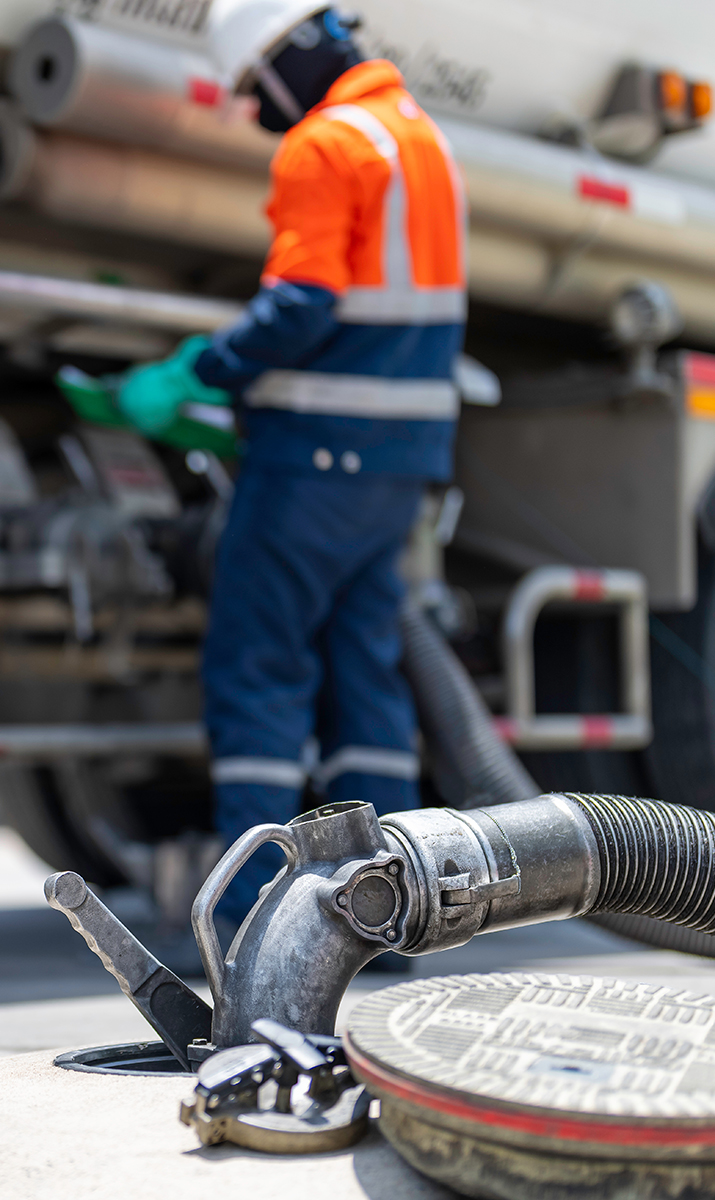
transportation-fueltruck-delivering-gasoline

CONNECTED GAS DETECTION AND LONE WORKER MONITORING FOR THE TRANSPORTATION AND LOGISTICS INDUSTRY.

Blackline can help mitigate risks for transportation and logistics workers with our ecosystem of connected safety solutions and analytics. We can help you get your workers home safe—every day—with lone worker devices, personal gas detectors and area gas monitors that protect them from explosions, falls, confined space hazards, dangerous toxic gases and VOCs, or working alone.

Veiligheid van alleenwerkers Persoonlijke gasdetectie Gebiedscontrole
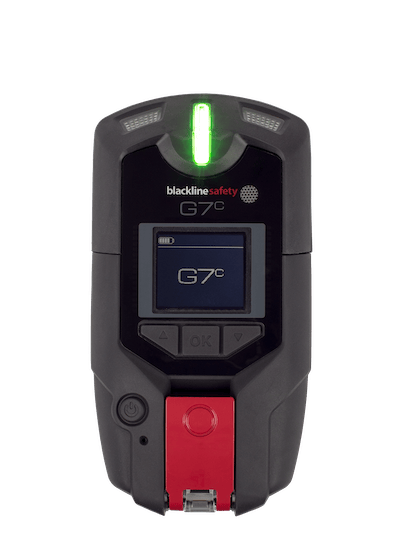
G7c-alleenwerkende-werknemer-front2 g7c-multigas-g7x-enkelvoudige-gasdetector

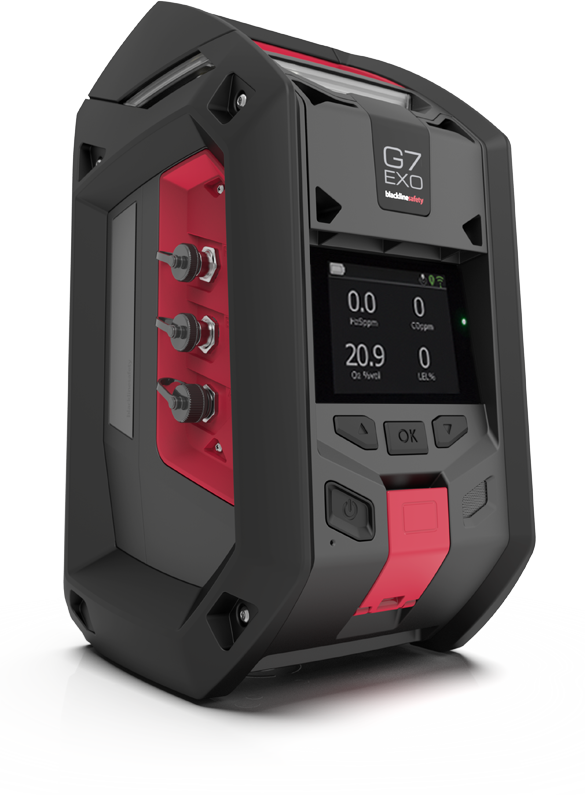
G7 EXO-gebiedsmonitor

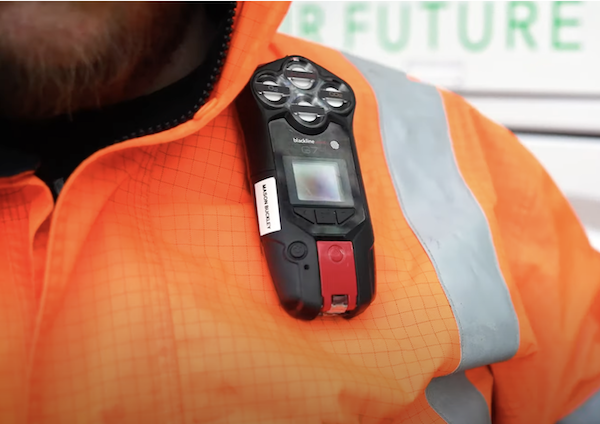
Lone workers such as drivers, surveyors / engineers, warehouse staff and forklift operators, all work independently at times in various roles and may require immediate assistance in case an incident occurs. 

MEER INFORMATIE

Various gas hazards may become present during transportation or hazardous materials. Workers need a connected safety solution like G7 to ensure they are always safe. 

MEER INFORMATIE

When it comes to monitoring the air quality in warehouses, refrigeration storage units or distribution facilities, G7 EXO deploys in minutes, delivering reliable connectivity for 100+ days. 

MEER INFORMATIE

Transportation and Logistics Toxic and Combustible Gas Hazards

  • Belangrijkste gasgevaren
  • Road transportation often carries the risk of flammable liquids and gases such as gasoline and propane which can pose a significant fire hazard in the event of an accident or spill. Poorly tuned engines or defective exhaust systems also run the risk of CO exposure.
  • Rail transportation also carries flammable liquids and gases such as ethanol, crude oil and propane. Transported toxic gases like vinyl chloride and other Volatile Organic Compounds (VOCs), chlorine and ammonia pose a risk to human health in the event of a leak.
  • Air transportation accounts for the shipping of 1.25 million packages of dangerous goods per year including flammable liquids and foods, pharmaceuticals and vaccines that use dry ice as a refrigerant which releases CO2 as it melts. Jet engines emit high amounts of CO2, and small amounts of NOx, CO, and VOCs.
  • Water transportation- flammable liquids and gases such as LNG are often transported via tankers which can pose a combustible gas hazard. The many types of confined spaces on ships are areas of risk where various gases can accumulate or oxygen can be displaced.
  • All methods of transportation emit CO from exhaust fumes, which pose a risk to workers and nearby communities.
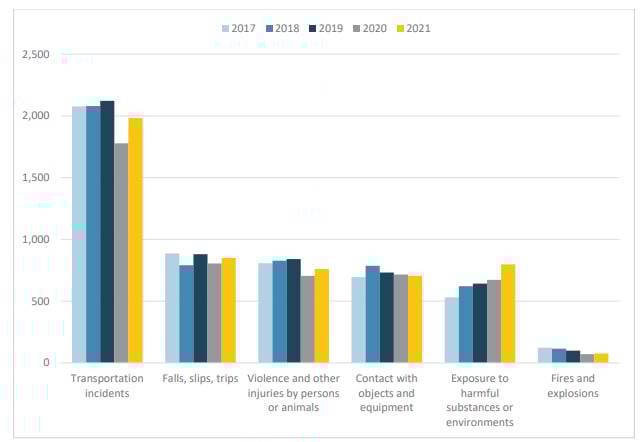
  • According to the Bureau of Labor Statistics, there were 798 worker fatalities from harmful substances or environments, within the US, in 2021.

In 2021, there was a total of 1,523 fatal worker injuries from transportation and material moving within the US.

(BLS, 2022)

Transportation and Logistics Lone Worker Risks

  • Commercial driving isn't a simple task. Accidents on the road are the most significant risk to transportation workers. Between 25-33% of all work-related deaths are caused by motor vehicle crashes (brightmile, 2020). In these instances, lone workers need an easy way to call for help. Our G7 lone worker devices offer fall and no-motion detection, missed check-in alarms and an SOS latch that can be pulled to call for immediate assistance.
  • Slips, trips, and falls are the number one cause of non-fatal injuries for transportation and logistics workers. Devices with fall detection can immediately alert monitoring personnel of an incident that may require assistance or medical attention.
  • Loading and unloading materials can cause injuries if precautions aren't followed. Forklifts were responsible for 70 worked-related deaths in 2021, and 7,290 injuries (NSC). Safety measures, like being able to pull G7's SOS latch can alert monitoring personnel of a lone worker requiring help.
  • Public transportation and logistics workers such as couriers can face aggression and violence when working with the public. 
  • Lone worker hazards like those listed above are the leading causes of workplace fatalities (BLS) and are common in the transportation industry, as categorized below.

Fatal work injuries by major event or exposure, 2017-21
logistics-transporation-fatalities-lone-worker


De connectiviteit en software om uw team nog beter te beschermen.

Blackline’s connected safety and robust software offering provide the transportation and logistics industry with solutions that offer ultimate protection from worksite hazards and help you run a more efficient operation.

Veiligheid van het volgende niveau – Via het online portaal Blackline Live kunt u uw G7-veiligheidsapparatuur beheren, uw faciliteiten en het welzijn van uw personeel in realtime monitoren, reageren op noodsituaties en rapportages maken op basis van verzamelde gegevens. Eenvoudige naleving is niet langer voldoende.

Ongeëvenaarde zichtbaarheid – Blackline Analytics biedt een compleet overzicht van de naleving, het gebruik en de waarschuwingsgegevens van uw verbonden veiligheidsvloot in één gebruiksvriendelijke tool. Analyseer realtime en historische gegevens om potentieel gevaarlijke situaties te anticiperen en incidenten te voorkomen.

Verbeterde productiviteit – Verbonden apparaten leveren gegevens die kansen kunnen blootleggen om de operationele efficiëntie te verhogen, waardoor miljoenen aan gederfde inkomsten kunnen worden bespaard.

Geoptimaliseerde reacties – Dankzij uitgebreide veiligheidsmonitoring en massale meldingen hebt u volledige en snelle controle over evacuatie en noodsituatiebeheer.

Altijd paraat – Het interne Safety Operations Center van Blackline is 24 uur per dag, 7 dagen per week bemand met professioneel opgeleide monitoringmedewerkers die zich uitsluitend richten op het waarborgen van de veiligheid van uw mensen.

De verbonden apparaten die u nodig hebt voor ongeëvenaarde veiligheid.

Met het uitgebreide assortiment veiligheidsapparatuur van Blackline krijgt u een compleet ecosysteem dat geen enkel aspect van de veiligheid van werknemers of werkplekken aan het toeval overlaat. Of u nu persoonlijke veiligheidsmonitoring, gasdetectie of gebiedsmonitoring nodig hebt, elke G7-oplossing biedt kant-en-klare connectiviteit en veelzijdigheid.

Betrouwbare bescherming – Vergiftig-immuune brandbare gasbewaking met breed spectrum LEL-detectie

Efficiënte uitvoering – Binnen enkele minuten verbinding maken, ongeacht waar het apparaat is geplaatst of gedragen

Gebouwd voor extreme omstandigheden – Bestand tegen zware en ruige omstandigheden, op elke werkplek, overal ter wereld

Klaar voor gebruik en betrouwbaar – Dankzij de batterijduur van meer dan 100 dagen van de G7 EXO kunnen apparaten langer in bedrijf blijven, waardoor er minder mankracht nodig is om batterijen of apparaten te vervangen en er minder vergunningen nodig zijn.

Directe verbinding met de cloud – Toonaangevende mobiele en optionele satellietverbinding voor afgelegen gebieden (bijvoorbeeld door de magnetische satellietbrug mee te nemen van uw vrachtwagen naar uw ATV), waarbij alle gegevens rechtstreeks naar de cloud worden gestreamd.

Lage eigendomskosten – Dankzij de extra lange batterijduur van de G7 EXO hoeft u geen extra monitoren aan te schaffen, wat u tienduizenden dollars bespaart. En met verbonden wearables kunt u een verloren apparaat gemakkelijk terugvinden.

Onmiddellijke bewustwording - Tekst- en e-mailwaarschuwingen houden u volledig op de hoogte van de status van het apparaat en actieve situaties.

Geen onzin – Maak LEL-correctiefactoren overbodig en minimaliseer onnodige en kostbare evacuaties als gevolg van valse meetwaarden.

Maximale flexibiliteit – Duizenden gasdetectieconfiguraties beschikbaar in detectoren voor één tot vijf gassen, met of zonder pomp

Compromisloze veiligheid – Uitgebreide veiligheidsfuncties voor personen, zoals valdetectie, alarmen bij gemiste check-ins, een S.O.S.-vergrendeling om onmiddellijk hulp in te roepen en bewegingsdetectie, tweewegcommunicatie en push-to-talk-functionaliteit.

AANVULLENDE BRONNEN

DE WAARDE VAN VERBONDEN VEILIGHEID VOOR DETECTIE VAN ÉÉN GAS

Gebruikmaken van gegevens om een proactief en efficiënt veiligheidsprogramma op te zetten


Verbonden gasdetectie is niet langer de technologie van de toekomst. Het is hier en nu beschikbaar, en voordeliger, duurzamer en eenvoudiger dan u denkt.

NIEMAND ACHTERLATEN

HOE VERBONDEN VEILIGHEIDSTECHNOLOGIE HET EVACUATIEBEHEER STROOMLIJNT

Evacuatiebeheer is een noodzakelijk onderdeel van de veiligheidsplanning voor olie- en gasactiviteiten. Het is van cruciaal belang om voorbereid te zijn om personeel snel en veilig te evacueren in geval van een noodsituatie, aangezien elke seconde telt wanneer er levens op het spel staan.

BRANDBAAR GAS EN DE DETECTIE DAARVAN WITBOEK

INFORMATIEBLAD OVER BRANDBARE GASSEN EN MPS-SENSOREN

Neem contact met ons op voor meer informatie.