Good morning, good afternoon, good evening, wherever you are. Thanks for joining us for today's webinar. We're we're delighted to introduce to you the the G8, Blackline's latest innovation and the most connected wearable ever made.
My name is Donovan Simon. I'm the Vice President for Client Success here at Blackline, and I will be joined, by Christine Gillies, our Chief Product and Marketing Officer, and Phil Benson, our Vice President of Product, in a little bit. Before we get into the details, a few fun facts about, Christine and Phil. So Christine studied, Japanese snow monkeys on a ranch in Texas when she was doing her anthropology degree. It's an undergraduate degree.
And Phil spent some summers in an egg processing plant inspecting hard boiled eggs for up to ten hours. I think both of those experiences led them into business and being great business leaders, and you'll hear from them in in a little bit. A few quick housekeeping things before we jump into the the meat of the discussion here. The session is being recorded, and you will get a link to the recording at the at the end of the session. We have also allocated some time for (Q&A) question and answers. Your part is to provide us with the questions, and we definitely will provide you with the answers. There should be a window either to the right or the bottom right of your screen where you can enter your questions, and we will definitely try to get to as many questions as possible, during the course of this webinar.
With that said, I'm gonna invite Christine Gillies, our Chief Product and Marketing Officer, to join me on stage and to to take it from here.
Thanks so much, Donovan, and, good morning, good afternoon, and good evening to everyone who's tuning in.
We're thrilled that you're joining us today to learn more about the G8, the most connected safety wearable ever made.
And here at Blackline, the team is extremely proud to introduce this latest innovation to all of you.
Donovan actually introduced, interesting facts about Phil and I, and, he brought this practice to Blackline. And so he's not gonna get off the hook even though he left the stage.
Donovan, has a long history of mentorship and, specifically focused on young men, and he is involved with a cause, a nonprofit called Boys to Men. I think you're gonna have to correct me, Donovan. Perhaps you even founded that cause.
And so, in terms of, comparative fast facts, I think, compared to egg inspection and observing Japanese snow monkeys, you win.
So, again, welcome, everyone. Here at Blackline, we're all unified by the same vision and purpose. And, ultimately, we're working really hard on technology for enterprise workplaces, and we're looking at transforming the industrial workforce through those, connected technologies.
But one of the things that you'll notice if you meet a Blackline employee is that we are all, singularly focused on a purpose, and that is that we are really focused on ensuring that every worker has the confidence to get the job done. They have access to the data, information, and tools that they need to get the job done. And then most importantly, that they will return home safe to their families at the end of the day.
And this is something that's palpable. You can feel this, again, regardless of which, organization or which department our employees are working in and which country they're in, is that we all come to work every day thinking about the workers that we're bringing home safe to their families at the end of the day.
We've, been at this at Blackline for, 21 years the company has been around, and we entered the connected safety era, approximately eight or nine years ago. And in that time, we have managed to work with over 3000 customers around the globe. And you can see from the icons on this graphic, where we have customers, and we're currently protecting a 165,000 workers worldwide.
In terms of which companies that we work with, this is just a sampling.
Blackline started out focused on the industrial workforce, and so, of course, the energy sector being right in our backyard here, that was a key focus area.
But now you can see a wide diversity of logos represented here. Fortune 500 companies, trust their people to Blackline. Consumer packaged goods, manufacturing, essentially anyone who works alone, we have solutions to be able to, protect those workers. And I wanted to give a shout out to a growing vertical that we're involved in is the fire and hazmat space.
And, so we have almost 500 or more than five hundred, I should say, fire and hazmat teams around the world who are choosing Blackline devices.
And you may have seen if you follow us on LinkedIn, that we were proudly part of keeping the Olympics in Cortina, safe and running in that the Italian fire brigade had chosen our, G7 wearables as well as our area monitors to protect athletes and the spectators on the world stage.
So when we talk about Blackline, it's sure most of you are familiar with the wearables, and it is true that we have a whole range of wearables in our portfolio. And here today, you're gonna hear more about the G8. But the entire Blackline platform is more than wearables. We have our area monitors, and, of course, all of those devices are consistently streaming data to, the Blackline Live portal, that's our cloud connected software.
It's really our key differentiator. It's where all of the rich data reporting analytics, where all of that is taking place. And then another key differentiator is that we offer 24/7 live monitoring. And so this is our safety operations center that allows for two way communication, voice communication, between our devices and, and Blackline.
Wanna share a story that really brings to life the power of this technology. Ty was an industrial worker, and he was checking on an inspection meter, doing a routine check, that he had done every week for many years.
And when he opened the door, a a gas explosion threw him to the ground and rendered Ty, sadly, burned his ears, his face, his hands, and he was knocked unconscious by the blast.
Luckily, he was wearing a G7 device, and that device not only detected the fall, but also the toxic gas levels were instantly transmitted to with an alert to a safety operations center operator who was able to see the alert, and instantly knew that Ty was in distress, in trouble.
The the safety operations center called Ty's device. And when he didn't answer because he was unconscious, they were able to immediately dispatch emergency services and save Ty's life.
And so this was a real incident that occurred over the about two years ago here at Blackline, and it really emphasizes how our solution with the two way voice, the real time connectivity was able to save Ty's life. If he was wearing a traditional beep and flash nonconnected gas detector, it would have detected the high level of gas, but nobody would have known.
And so we heard from this customer, from this client that we most definitely saved Ty's life. And so and that's why we come to work every day with our purpose and mission or our vision and purpose rather that I mentioned earlier.
Okay. So we're gonna get into the G8 next. And, but when you think about the connected safety landscape or rather the evolution of connected safety, you can think about it somewhat as the technology adoption curve is that when we first entered this space, it was largely manual. In fact, there's still a lot of manual work that happens in the industrial workplace overall, checklists, spreadsheets, paper based systems, very manual.
When we entered with the G7 almost 8 years ago, that's when we you saw a more proactive era, cloud connected devices, real time monitoring, preventing, incidences or improved reporting and compliance with that data that was being, instantly collected. But now with the G8, we're moving into the connected era, and this is where we're really looking at, more productivity benefits associated with this data collection, the application of AI to all of those data points, and moving into a more proactive and predictive era. And we've been working for the last four years on developing the G8, and I am very proud of the response so far. I'm proud to introduce this product. It's been very positively received over the last four weeks that we've been in the public. And so without further ado, I'm going to invite Phil Benson, our Vice President of Product, up onto the stage, and he's gonna unpack exactly what the G8 does, and then we'll have time for questions at the end.
Thanks, Christine.
Interesting intro to talk about my history inspecting hard boiled eggs, but it's a different world now.
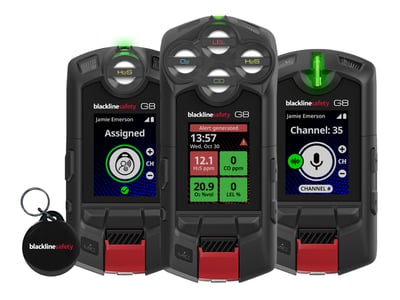
So this is the G8. So I'm gonna I'm gonna talk about these features. There's been, so much added to and included in the G8 that it's sort of tough to cover it all in one session, but we're gonna focus on the highlights here. So, so I'm gonna start by quickly touching on each of these, and then we're gonna dive into them a little further.
So and as we think of these, you you know, they they've all Christine talked about our customer base. You know, we've been selling the, G7, which is the predecessor to the G8. Many of you are familiar with the G8. Hugely successful.
Really, it sort of pioneered, connected safety in context with gas detection and communication, with push to talk. And so and that's been in the market for seven or eight years now. We have over three thousand customers. There's tens of thousands of G7, in the field with users.
And the G8 is really a culmination of all of that feedback. We've been working on the G8 for about eight four years now, but we've had years and years of feedback on on the the G7. And so so that's what this feature set really speaks to. It's sort of designed for those customers and the people that were really in the field.
We'll talk about that. So to go over them, people wanted to see tag assign. So this is it makes it easier to deploy devices in the field and have the user of that device, they can switch between any number of devices. So you can have a pool of devices, and a person can come in the morning, choose whichever one, and assign themselves to it without having to use the cloud software directly.
Really, high visibility, clear interface, and clear LCD. So we had a lot of feedback about making a bigger, brighter, clearer, interface so people knew what was happening on the device.
Also, dedicated buttons. It was really interesting from a user experience and industrial design point of view as people were saying that, you know, more buttons is not always more complex as long as the buttons are dedicated. If people understand what they do, it's actually faster to get to those functions. And that was especially true of people who are using push to talk on the G7 is they wanted a dedicated push to talk button, and they wanted to either change the volume or change the channels with very quick buttons just like a radio. You can do that very quickly. So we heard that added it to the G8 platform. We have larger buttons in general, so the interface is is easier to access, when people need to get in there and do something.
The we added a much louder speaker, much clearer speaker for clear voice and loud alarms.
That there is also a feature on the G8 that was a flashlight. It it was on a majority of the new cartridges, and that was really popular. It was, sort of interesting that people were saying, you know, they want the device to be useful much like your phone, where you use the flashlight function, is it seems really simple, and in a lot of ways, is, but it's incredibly useful. People need an intrinsically safe flashlight. Those are not always cheap and handy, in dim environments, confined spaces. So so a dedicated button for that so people didn't have to go into the menu. That was a convenience feature that people really asked for.
In addition to that, just a ruggedized design. We especially heard from our our great customers in fire and hazmat. They need something that's bulletproof. Yes.
This is high technology. There's there's lots of delicate instrumentation in there, but that doesn't matter when push comes to shove. And so for fire and hazmat, we really heard that. Oil and gas as well, those are those are really, serious industrial environments, and equipment needs to stand up for the long term.
And so as the the G8 is really redesigned from the inside out, there's no really component within the G8, that that is the same as the G7. But we really also heard from customers that it was important that the G8 not be radically different. They wanted to make sure that you could take a G8 and add that to a fleet of G7 really easily so that trying to keep the interface as similar as possible so that a person who's used to using a G8 can just start, sorry, a G7 can just start using a G8 so that it can it can, you know, be added to that fleet. So
people had to be familiar with the look and feel, you know, understand where the latch was, know about the three interface buttons, where's your screen, where's your sensors, how do I mount it. But then, and, also, don't increase the size. So we've managed to do all of this in the same form factor as its predecessor, the G7, and that's a a real achievement. I mean, under the hood, there's been huge advancements in getting all of this technology into a smaller package.
That includes a 20% bigger battery. Like, we're we're running very sophisticated and improved, four g cellular and, better GPS, GNSS for locations. Right? So this is your, location GPS.
And and all of that requires more power, but we also wanted to extend the battery life. And we've managed to do that in the same form factor as the G7. So I'm gonna go through and dive in on a couple of these topics. Again, listening to our customers', feedback on the G7 was that a bigger, brighter display was huge.
You can imagine, or some of you are familiar with firsthand, when you're in the field and you're doing industrial work, you're wearing PPE. You're wearing personal protective equipment. Often, this is, you know, glasses or goggles. Sometimes it's a face shield.
Sometimes it is a full SCBA face mask cover. When you're doing that and you hear your device go off, you need to really quickly be able to look at that and, know what you're supposed to do. You're focused on your job, and you don't need a distraction from something else. So when it does happen, you need to be able to look at that and really quickly identify the problem and know what you're supposed to do.
And especially if you're gonna use any of the advanced functions on a device, you need that to be really clear, easy to operate. So the screen is twice as big as the G7. It's a 64 color screen that helps you really differentiate between alarm elements and interface elements.
Also, it has a 188 pixels per inch, which is really amazing, especially for an intrinsically safe device. We also heard PPE on hands, obviously, gloves. Almost every operation in industrial workforces, has, they're wearing gloves of various shapes and sizes. And so that we really took to heart.
We made the, the core interface buttons, the three buttons there, much bigger, much easier to press. And, also, in adding the buttons on the side, those are easy to access, easy to press with gloves, and that was important to design. All of this is incredibly rugged. As I as I've mentioned, we sort of, you know, took took a look at the, internal components and the structure right from the beginning to make sure that it was, you know, IP67.
That's for water ingress protection. Right? You need that to be, water resistant and, but then also really, really rugged. And then as I say, having a flashlight, really important to our users.
The biggest change on the G8 is in communication, and this this is at a number of different levels. Right? Communication has been increased. There's a a four g LTE antenna system. It uses what's called a diversity antenna system, which is two antennas, and that allows you to have essentially better connectivity.
And so better connectivity has been improved. Also, just the voice quality on the hardware. There's a bigger speaker, bigger, more powerful speaker, and it also has a very large acoustic chamber behind it. This is really a space if you look at any home audio equipment, really quality audio equipment, it, your speakers have this sort of big empty area behind them. That's an acoustic chamber, and that, allows you to have very clear sound, and, and, really, your your resonance is much better. And so we've actually managed to fit an acoustic chamber in behind the speaker of the G8 to really enhance audio quality.
And, so that's what we heard from people in the field. They like the G7, and they like that it had PTT, but it needed to have, like, crystal clear audio quality and needed to be loud. And this helps in a number of ways. Right?
This helps in push to talk. This is equivalent to a radio where you're pushing. You're holding down a button. You're able to speak to your team, and then you can release, and then those people can speak back to you.
You need clear communication. But then also for emergency voice calling. This is what story the story Christine told really relates to is that really often as part of our solution, there's there's a two way voice communication between the person who's having an incident, having an issue, and then the responder on the other end. And sometimes this is, hey.
I'm okay. That was a false alarm. And really quickly, that's resolved, and sometimes it's not a false alarm. And having a clear communication of what that person's saying or even the environment around them is really critical for a safety device.
And not only are we talking about when we talk about the most connected safety device ever, we're not just talking about cloud connectivity. We're talking about voice. We're talking about connecting to your team. We're talking about connecting to your supervisors, but also text messaging.
Right? Being able to shoot a text that someone can read on their device. That's really handy for musters, like a real life muster drill. Also for muster, you know, yeah, muster drills.
When you're when you're practicing musters, you can mass communicate to to many devices at once with text, and that's really important.
As I say, we really leaned into voice. We really did a lot of research and listened to what customers want. And, yes, they wanted a dedicated device. They wanted a device that said, I can do gas detection. I can do loan worker, but, also, I can do voice. So so we've done that. We've improved it on the hardware side, on the device itself.
But, also, they said we really want a lot of these, customers that work in the field, they need a lapel mic. Right? So this is a separate RSM speaker mic, and they use it for radio communication. I mean, anyone who's in emergency services, police, I mean, they understand what I'm talking about.
Is having a lapel mic that's very close to their ear and where they're speaking with their mouse mouth, a big speaker on it. So you can see in the picture here that the G8 is actually compatible with a a Blackline offered RSM speaker mic. So this is IP67. It's intrinsically safe.
Does not need to be charged. It doesn't need to be Bluetooth paired. You literally plug it into your G8, and then all of your voice communication can happen on your lapel, which is away from your gas sensors. So there's multiple ways to get really high quality voice communications on the G8 and potentially replace radios.
If you do any sort of digital voice things, definitely be able to replace those.
Not only has the hardware been really improved, but BlackLine Life, that's our cloud, our cloud software services, are also seeing improvements. We've we've tried to time the release of geofencing, so we call this ZoneAware. It's our first, it's our first block of features into, geofencing. We're timing that within a couple months of the release of G8.
So that's really exciting too. We heard from a lot of customers that having a location was incredibly important to them, but they needed site context. Right? If their their site there were certain areas that were work zones, some area that, some areas that were more dangerous than others.
Some of them were muster areas, and context was incredibly important for them to know at a glance without counting on the screen, but to know at a glance how many people are in which zone was incredibly important.
Blackline already has, you know, fifteen essential reports. There's lots of ways to get the data that you're looking at, and, people also ask for a zones report. We've been making these as custom reports for years for our customers, and now we're we're offering that to our entire customer base. If you utilize zones, you get this really rich zones report, and that can tell you how much time people are spending in each of these zones.
So you can think about that from a productivity point of view, but you can also think about it from mustering. Right? How how long were people in the dangerous zone after the drill started? How long were they in the mustering zone?
Did everyone leave that zone? Am I getting better at this? And so there's a lot of really powerful capabilities with being able to understand zones and have that awareness. Not only can you draw these zones manually in Blackline Live, but you can also upload thousands of zones at once.
So you can take a KML file.
Often, if you have a GIS team, they'll be able to export for you a KML file of many thousands of zones, and you can just upload that really easily into Blackline Live. So you can have it sort of coordinate with whatever system you're using externally and then have that context for your first responders, for operations all within Blackline Live. And I I talk about ZoneAware being launched, you know, within within a similar window as the G8, but, but it works for all of our product lines. So zones will work for your G7s. You know, it'll work for whether they're G7c or G7x. It'll work for your EXOs, right, your area monitoring, EXO8, G7x o. So it works with the the Blackline portfolio.
And if you're interested in ZoneAware, we're already beta running this as as a beta program for many of our customers.
And, so we're we're putting it through its paces. If you're interested in this, reach out to your sales team. We can turn this on for you in advance, but you will see this in the coming months, probably about two months, and it will be turned on for all of our users to see and explore regardless of service plan.
The next one I mentioned was tag assign. So this one, I think, you know, the concept here is pretty straightforward. It's to say, instead of having to go into Blackline Live, log in to software to change who is using this device on a particular day, I can instead do that on a tag. I do this once on a pretty inexpensive on a inexpensive tag that I can have.
And then I can put tap it on my device, and then I'm able to assign this device to myself. Right? And so then it has my identity. It knows that, for example, Phil Benson is using this device.
So that's really important for a number of reasons. One is your your deployment in the field and being able to have a shared fleet of devices, like a charging bank full of devices. I can pull off anyone I want, tap, and assign it to myself. Really important, for our users.
Makes makes it very easy to deploy and maintain devices in the field. And then, also, I'm able to respond to me, to Phil Benson. Their emergency situation, you know who you're looking for. You know who you're talking to.
And, also, it's collecting the data. Am I using my device? Right? Our customers have invested money in a safety solution that is very important to them, and it mitigates their risk.
And you wanna make sure people are using those assets. Right? And, with Blackline, you get the visibility to say, who is using this thing that that I have provided for them? So you can get reports on that, and you can also see our people maintaining it.
Are they bump testing? Are they calibrating like this? So it really helps you manage your fleet and manage your investment and understand the data, understand what's happening in your field, who's getting exposures where and at what time, and Tag makes that really easy.
The next is just general visibility and compliance. So I talked a little bit about, you know, visibility in the sense of zones and visibility in the sense of tag assigned, making it really easy to understand who's using devices.
And G8 feeds into all of those essential reports. So if for our customers who are who are using G7 reports and really found value in that data and the multiple levels of data they had access to, the G8 fits seamlessly into that. And so, as I say, you can have a fleet of G7s, and you can start adding G8s, and then that will all feed into that same dataset and be able to contribute appropriately. So so we have some really rich reports. There's a lot to get into there. I won't take a tour of Blackline Analytics, but, but G8, plays really well in that world.
And all this is built on proven gas detection. So, you know, we've a a lot of us even prior to Blackline, myself included, have a gas detection background. We've been doing this for a long time. We started with Blackline.
We brought that into the connectivity space. So the G8 uses the same smart cartridge system that we use on the G7 and on the EXO product line. So that same cartridge system that allows really a high degree of flexibility, there's, you know, we we provide over twenty different sensor options that would go within these cartridges, and then the cartridges themselves have flexibility. So you have a a loan worker cartridge that doesn't have any gas.
And on the G8, that's, like, ideal for communications. It's wonderful. We also have a single gas. We have a four gas cartridge and then a four gas with a pump.
So there's lots of options, and they all work, with your G8.
All of the the newer cartridges from last year work on the G8 have backwards compatibility. So so it's really flexible gas detection system.
And this is all in one, you know, a proven connected platform. So Christine talked a lot about the platform, about the the how valuable it is to have all of these pieces and sort of one stop shopping, so so that you can really focus on the solution.
So the G8 really leans into loan worker protection. That's always been a part of our our, sort of the backbone of what we do at Blackline Live is keeping your people safe. Radio communication is the huge improvement for the G8 is that you're you're getting, you know, sort of radio quality best in class communication on this device, and then that's coupled with modular gas detection. So so you've got the hardware side of it really locked up.
But then you also get site visibility. Right? I've talked about zones. This also works with alert link.
So last year, really sort of exciting feature that Blackline, came out with was the ability if one device has an alert, it essentially is able within a radius, within so many miles of that device, it will alert devices close to it. If the device is too far out of context, then it won't alert that device. But anyone that is close to it will, and the G8 works within that architecture, within that solution. There's also automated reports.
And all of that coupled with twenty four seven live monitoring and emergency response. So you can either respond, your company can respond to its own employees if you're set up to do that. If not, Blackline can do that for you. We have our own safety operations center that runs twenty four seven, and you can also use a monitoring partner.
There's a partner you already use for twenty four seven monitoring for any reasons. You can use those partners as well. So it's a real ecosystem. It's kind of sort of a turnkey solution that all of this plays into.
Another important thing I talk, you know, I've I've mentioned a lot about how important it was for our customers to be able to have a fleet of G7s and then be able to integrate the G8 into that fleet relatively seamlessly. Big part of that is accessories. You don't wanna have to swap out all of your docking stations. And so with the G8, you're able to use the exact same docking stations for bump testing, calibration, a gas application that you use with your G7. So if you already have those, they're you can use them without any changes.
And they're also just the docking station in and of itself is relatively inexpensive, very easy to deploy for expansions because all of the sort of intelligence is on the device side. So it allows you to have this really quick, easy deployment of of a fleet of devices, and and and it fits right in.
Also, the cartridges. So I mentioned it uses the same cartridge system. Little caveat there is it'll use the newer cartridges. There was, like, a certification change, on with, you know, LEL, lower explosive limit, sensors, that came into place, and so we've accommodated that, certification change by a third party.
And so it's all of the newer cartridges. So any cartridge, if you look on the back of it, you look at a cartridge from Blackline. If it has an f two, in the model name, then you know that it will work with the G8 and work backwards compatible. We started shipping those in sort of May of last year.
So that's why I say any of the newer cartridges will work with the G8. And then this it'll use the same tubes, pumps, filters, etcetera. So so very easy to have it integrated with your fleet. Some of the things that were new, we also got feedback from our customers that said, here are some things you need to change.
And one of them was the the charging. Said that, you know, change your charge clip. It needs to be stronger. It needs to be easier to use, more robust.
So we changed that that, charging mechanism on the on the back of the device, the interface. We've also changed the multi bay charging accessories. So if you were charging fives or twenties of our devices, you could buy these bays. We still have those.
We have a really slick, new five bay charger, and we have a a new, twenty five bay charger. Twenty? Twenty five bay charger. Twenty five.
And, so those are those are new accessories that are much easier to use. It's really easy to just drop a device in. People found the other ones were a little finicky, sometimes they would break. And you can't have that in industrial environments and hazmat environments. So so we made some great charging accessories.
There's also new click fast connectors. So click fast is a way for, if customers don't wanna use the, alligator clip on the back, you can have this accessory that that, will allow you to you know, all different ways that you can wear the device.
Speaking of the alligator clip, another, sort of important update for people who are, interested or have used the G7 is this is much more robust, is that what we found is that sometimes these clips because the environments were were so sort of extreme or people were doing a lot of confined spaces with these things, very rough on the devices, that we've we architected the way that these, the clips work. So they really retain the clip now. So there's lots of quality changes on on GA.
Now I'm gonna pass it back to Donovan. Thanks so much for your time, Donovan.
Thanks, Phil. And, of course, I'm gonna encourage everybody that we will dedicate some time for question and answers here in a few minutes. So there's a question section. Straw your questions in, and we'll get to them, in in in a little bit.
While we're discussing the G8, I think it's important to ensure that everybody understands that we still have a broad portfolio of products. There are wearables, single gas, multi gas, loan worker, available. We've got our our satellite solutions, so that's G7x and bridge, which is still available and remains a key part of our offering alongside the G8. There's the error monitors.
That's our x o eight. And, of course, our our software and services or Blackline Live, etcetera, supporting real time monitoring and alert management.
We've also taken the opportunity as we introduce the G8 to to rationalize our service plans to make it easier to understand, to ensure that you can grow with us, and ensure also that you can we can support your safety programs long term. You can jump on our website and have a look at the the service plans and how these can fit into what your requirements are. In in addition to looking at our service plans, we've also ensured that you've got the buying options that support your circumstance. So the GA will ensure that we we continue with the GA to offer flexible buying options. So whether you want to use OpEx or CapEx, you can purchase, which allows for upfront, billing. You can lease, which locks in an arrangement for up to forty eight months. There's also the flexible option of of renting if you've got short term projects that are daily, weekly, monthly that require our solution.
In in some regions, lease options are are not available. But in conversation with your Blackline representative or a Blackline authorized channel partner, we'll definitely be able to find the right buying option, for you.
Orders are being accepted now, so feel free to have that conversation with a Blackline representative or an authorized channel partner, and we will be shipping in early March.
Before we move away from the the whole solution, I think it's important to also call out our best in class customer service and support.
This is not just us introducing another device. We're making sure that you get the entire team behind you to ensure you extract full value. So there's twenty four seven customer care. There is a team that supports you with onboarding, implementation, and change management.
And we recently launched our new Blackline help center where you can get tools and resources, how to guides across all our products, including the G8, to help your overall experience as you implement, as you transition, as you take on Blackline as your solution of choice.
Before we go into q and a, I want to talk a little bit about our keeping people safe report.
This is something new that we're we're we will be introducing where we went out and we did an anonymous survey with about two hundred safety and operations leaders across the US, Canada, the UK, Europe, and Australia.
We did a a seven piece in-depth interview with them to to get their feedback. There's a QR code on screen if you can scan it to sign up. Because with that, we're also going to incorporate over three hundred billion data points that we have already collected to deliver this report that gives you insight on patterns and a range of information that help you as you make your decision around the solution that you use to protect your people. So scan the QR code, sign up for that report because I think we it it will provide value to you and your team. So we've unpacked a little bit of the detail around the G8. I'm gonna invite Christine and Phil to join me back on stage because now we're gonna tackle some of your questions, and there are quite a few.
So let's see if we can jump in here quickly.
Phil, I think this one should go to you. It says, with with the larger display, what is the expected battery life?
Yeah. Great. Good question. So, not only is there a larger display, which can use battery, there's also, you know, better, four g antennas, more connectivity that can use battery.
There's also GPS that can use battery and NFC for the tag assign. So we actually you know, part of the architecture, we put in a twenty percent bigger battery. So our goal initially was to just have the same run time. So the G7 currently runs at about twenty hours.
This is in, you know, sort of, like, room temperature conditions, right, newish battery. But that's the goal with the ultimate so that you can you gotta be able to run at least a full shift. So that's where the twenty hours comes from. So the goal is twenty hours.
We're actually trending higher than that. Right now, I think we're gonna be able to change specification from about twenty hours to about twenty four hours. So that's not quite official yet. We're doing, like, long term testing right now, so I'll guarantee a twenty.
But I think we're we're we're trending around twenty four, and I think we'll be able to change that spec shortly.
Alright. Sounds good. Thank you. Christine, let's let's bring you in. Here's one I think you can talk. It says, what is the warranty on on a G8?
That's great question.
On the G8, we're offering a two year warranty, and that's on the base unit and the sensors. And we also have the option to extend that. So you can add up to three years for a total of five years for the warranty.
Okay. Awesome. Thank you. So basic is two years. You can add up to three years.
You got Increments at one year.
So, more technical questions. Phil, is the remote speaker mic intrinsically safe?
Yes. It is intrinsically safe. So that's class one div one zone zero, which is the same certification as the G8. So anywhere the G8 can go, the RSM mic can go as well.
Okay. Awesome. Is how does PTT work across teams in different locations?
Right. Okay. Yeah. That's a good question because it really highlights the difference between the reason we call it PTT compared to, like, a radio technology.
So with radio technology, obviously, it uses electromagnetic waves. That distance is important. Right? Like, see, are you in range of radio, or are you not in range of radio?
PTT is different because it's a digital voice communication. So if, in this case, your G8 has a green light, it's connected to to the system, which is gonna be even more prevalent with the new, antenna system that we have in the G8, very strong connectivity. So if you have connectivity on the devices, it actually range doesn't matter at all. Like, I've spoken with colleagues in Australia using a G8 just last week.
And so so range or, in Texas, actually, just the other week, I was talking to Jesse Wyckoff. And so, so so range is is irrelevant, when it comes to this. So PTT is really powerful, for those situations. Now you can do this with radio.
Like, you can have repeaters. You can actually set up a radio system that will digitize voice and then be able to transmit that so you can but that that's expensive. It's costly. It requires a lot of this infrastructure.
With the G8, just like out of the box, two people will be able to turn them on within the same organization. So in Blackline Live, if you have an organization that's, like, your company's devices, they would have a hundred channels that they can choose from to talk to one another. And those will not interfere in any way with a different organization. Even if they're working right beside you, they have a different set of one hundred channels because you're different companies.
And so so that's kind of the beauty of this is people can't just tune in to your radio frequency, but then also it distances don't matter. So it's a real strength of a push to talk system.
Yeah. And and and even though you've kind of intimated this, there's another question that talks about the effective range of the push to talk system. Yeah. But do you wanted to half a second on that one?
Yeah. Definitely. It's very related. Yeah. It's a good one, Donovan, is because, you know, as I say, there there because there is no range, it's people ask those questions because they're so used to radio systems.
Right? And, like, can one site talk to another site if they're x amount of miles away, or do I need a repeater? And with a push to talk system, like with the G8 system through Blackline, it doesn't matter how far those sites are away. You can be in different countries, and and that's okay.
You can be on different cell carriers because with Blackline, you don't really care what cell carrier you use. That's that's not, something you need to worry about. So so we work on multiple cell carriers. As long as your devices are connected, then you're good.
You you can you can speak at any distance. As I say, around the world, I've talked to colleagues in Australia, talked to them in Texas. I'm here in Calgary, Alberta. You can talk to, the UK.
So so they're all different places. So so range is no longer an issue, and that's a big strength of a digital system.
Awesome. Thanks. Alright. Here comes another one that says, will the G7 be discontinued, or will it coexist with the G8? And for how long will it be available to to incumbent customers?
Yeah. Good question. There will be a period so there will be a period of time where you can purchase either a G7 or a G8. Right?
So for about six months, you'll have the opportunity to buy a G7. And we did that just to, you know, not force anyone's hands. These are safety devices. We understand you have SOPs.
The change takes a bit of time. Totally understandable. So we've given about six months of time where you can buy either or. What we I mean, the G8 does everything the G7 does but better and has more features.
And so so what we've seen is, like, the the uptick of people using a G8 making that choice in the next six months is gonna be sort of a dramatic shift. But we guarantee that we'll let people purchase it for six months. Wonderful. Anyone who's purchased within the last six months is gonna be we will we will stand by our warranty on that.
So if you just bought a G7, don't worry. We've made sure that we have parts and services to be able to take you through to the end of your warranty. You can obviously switch to a G8 early. Wonderful.
But you don't have to. We're gonna stand by those devices and support them for the extent of their warranty.
Awesome. The questions are are coming in furious here, so I'm gonna try to get to as many as I can.
Can the G8 start in pump mode, or do you still need to go into the menu and toggle device into pump mode?
Yeah. Good one. Talk about customer feedback. My goodness. I thought we were so clever with being able to turn off and on the pump.
And, and some customers love it and some hate it. And so great one. So the G8 resolves that.
You can in your configuration profile, these are the instructions in Blackline Live that tell your devices how they operate. You can turn on so that the pump is always on. So you can have it so that I press the button on the device, it powers up, and the pump will like, you'll do you have to do a block test, so that's just something you need to be able to do for safety. After that block, the popped the pump is running. So that's your choice.
oK.
And and this one, maybe, Christine, know, bring you in here. It says, is is the one tap device tag assigned, is it an extra or a standard feature?
Good news.
Tag Assign is included, in all of the service plans. We wanted to make sure since that was a highly requested new feature that allows you to get dozens of workers up and running quickly. We wanted to be able to offer that to everyone. So it's included in all of the service plans.
Awesome. Thank you. Alright. Phil, cell connectivity. Is the cell connectivity the same hardware as the G7c?
Good question. Yes and no. It is totally different hardware. So that's at a very sort of nerdy engineering level is it uses this diversity antenna system.
So the connectivity is gonna be better than the G7. Right? We've really optimized the way that it connects. However, it's still four g LTE, and so it's not, it actually has a fallback to three g.
So in situations where you have older, sort of, cellular, infrastructure, that's okay. But it it uses four g LTE, so, like, high high speed like that.
Actually, I saw a question, Donovan. I'm gonna jump ahead. Someone asked about five g connectivity. I was actually really that.
Yeah. Yeah. So five g, if you really dig into that, it's a really interesting space. There's sort of like you'll see on your cell phone often, it'll say five g, and what it really means is you're using high speed four g LTE.
It's it's sort of like a complex architecture, but there is legitimate five g architecture. It's a different thing. The G8 doesn't do that. That infrastructure is not mature enough yet for a safety device, not that it is unsafe.
The point is it doesn't have the connectivity and range and coverage that we as a safety company with the with the, you know, the the range that we have and the how robust we need that infrastructure, we're not ready to move to five g yet. I'm sure someday we will, and, like, our customers will come with us on that journey. But, but this is a four g LTE device with a backhaul to go to three g older infrastructure. So that's that's what the, G8 really focuses on.
Okay. Awesome. Thank you. Is there a plan to have a G8 x to connect to the bridge?
Good question. So so that ties in. If people are familiar with our product line, I hope you are, there's the G7c. That's a sell cellular device, dedicated cellular, and that's what the G8 is replacing.
Right? There's this other product, and that is the G7x, and that works in conjunction with a bridge. Now that is a cellular and satellite device. So if you have no cellular connectivity in in certain areas, you can use the G7x and bridge.
That product is going to stay, in the short term I mean, in the foreseeable future, because the G8 does not replace that. That is an excellent and robust satellite communication system. It's it's really good. That being said, I mean, we're a technology company.
There's a lot of changes happening in the satellite communication world right now with low orbit satellites. Do we have our eyes on that? Definitely.
So so they'll be in future, that'll be something that we think about. Right now, we're focused on having best in class cellular. It's a huge part of our portfolio. The kinda demand was heavy from our customers, especially for voice services. So the G7c or sorry. The G7x and bridge continue to be part of our portfolio. If you need satellite communications, it is an excellent product, and that doesn't change.
Awesome. Alright. Listen. The clock is ticking until it's time time to wrap up. If we haven't answered your question in the q and a, a member of our team will answer those questions directly.
I want to thank you all for your time. But before you go, there's a QR code on the screen where you can scan if you don't have an you know, a a Blackline representative already. You can arrange a demo. Somebody from our team will definitely reach out to you, or you can get in touch with, a Blackline authorized channel partner if you have already built a relationship with one to get more information about the G8 and, of course, the portfolio of solutions that Blackline has to offer.
Thanks to Christine. Thanks to Phil. Thanks to everybody on the production team for making this happen.
Sign up for the keeping safe, keeping people safe report as well. We we appreciate you if you're an existing customer. And if you're not, join us because we'll appreciate you too. Thanks. Enjoy the rest of your day.