


Blackline Safety is a technology leader driving innovation in the industrial workforce through IoT (Internet of Things). With connected safety devices and predictive analytics, Blackline enables companies to drive towards zero safety incidents and improved operational performance. Blackline provides wearable devices, personal and area gas monitoring, cloud-connected software and data analytics to meet demanding safety challenges and enhance overall productivity for organizations with customers in more than 75 countries. Armed with cellular and satellite connectivity, Blackline provides a lifeline to tens of thousands of people, having reported over 323 billion data-points and initiated over eight million emergency alerts. For more information, visit BlacklineSafety.com and connect with us on Facebook, X (formerly Twitter), LinkedIn and Instagram.
 Translating data for the daily worksite with Dr. Lori Guasta
Blackline Safety conducted research for a report called Keeping People Safe: Global Data on the State of Workplace Safety in 2026. The results came from a third-party survey of 200 safety and operations leaders from around the globe, representing six different industries.
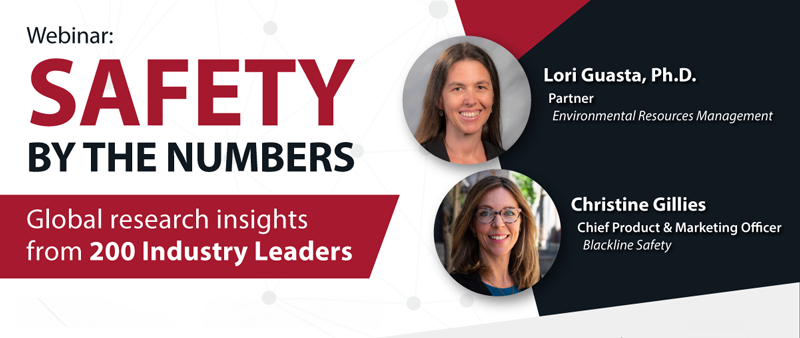
To discuss some of the real-world implications of this research, Blackline’s Chief Product and Marketing Officer, Christine Gillies, was joined in a webinar by Dr. Lori Guasta. Dr. Guasta is an interdisciplinary scholar-practitioner whose work bridges sociology, organizational leadership, and applied research. She has led research and improvement initiatives in high-risk industries through her roles with the National Institute for Occupational Safety and Health (NIOSH) and in private consulting. She has published and presented widely at professional conferences and executive forums, focusing on leadership, organizational behavior, risk management, and safety culture.
Here are some of the key moments of their conversation. Watch the full webinar here.
Q+A:
Blackline: One of the findings from our research is that 97% of safety and operations leaders believe that workplace safety is fundamental to reliable productivity. How do you see that showing up in real world work?
Lori: Safety isn’t just about preventing incidents — it's also about enabling performance, and there are a lot of other inputs that go into performance. In strong safety cultures you see reduced downtime, improved quality, and trust building across teams. The Occupational Safety and Health Administration (OSHA) found companies that invest in safety programs see some pretty good measurable returns, fewer injuries, lower costs, and higher productivity.

It's great to see that 95% of organizations either plan to maintain or increase their budgets, which, to me, really shows that safety is seen as a smart business investment, rather than just a compliance box to check. It's also really encouraging to see how that spending is expanding. In addition to the typical spend on training, today we're seeing more focus on engagement, on improving infrastructure, which includes technology, and I was really encouraged to see increased spend in internal advocacy. All these things build a stronger safety culture.
One of the less optimistic report findings is that 64% of safety and operations leaders see a disconnect between safety protocols and real-world behaviors. What’s happening there?
Lori: That gap often comes down to some of the hardest things that safety professionals are trying to tackle, and that's culture and effective communication leading to engagement. The encouraging part here is that when we recognize that this disconnect exists, it's the first step towards closing it or addressing it. And a lot of companies, at least in my experience consulting, are starting to focus more on that science of human behavior. It's this understanding of why people behave the way they do and how we as leaders can design elements of our systems to fit real work.
Zero-incident goals have long been the standard, sometimes to the point where people don’t feel comfortable reporting near-misses. What’s the value of calling out near-misses and even celebrating them?
Lori: I think a way that we can shift or reframe this message is to measure and celebrate different metrics. A zero goal is very stuck on lagging metrics and looking backwards. Instead, if we shift focus to leading indicators and showing and celebrating proactive safety performance, not just negative outcomes, we might motivate different behaviors.
What would it be like if that “0 days since an incident” sign said: “we learned from four close calls this month, way to go”? It's more about acknowledging that close calls happen and we're learning from them.
Safety leaders told us that better training is a path to greater trust in safety procedures and tools. What does “better training” mean to you?
Lori: Better training does not mean more of it. It means more relevant training. We're adult learners and we demand relevance in the information provided to us. Unfortunately, there are companies that all they do is safety training, and it's typically to help organizations stay in compliance, but it's very still top-down. Information goes out, we hope that behavior changes, but it’s not guaranteed.
Culture doesn’t work that way. If we want to leverage what good training looks like, it really is at that foundation of culture where trust gets built. And that's one of the ways we can get there — we can significantly impact learning when we make the training relevant.
Only about one-third of leaders are spending time on predictive analytics that have the potential to forecast and even prevent injuries. And organizations are sitting on so much valuable data without fully leveraging it to create prevention tactics. Are you seeing a shift in how companies are starting to use their data in the field, Lori?
Lori: Absolutely. And I agree with you, we are leaving a lot of value on the table with data. A lot of folks are still using safety data like a rear view mirror, looking backwards at incident reports, recordables, root cause, findings. And these are really important! But they're all after the fact.
I think the shift we're seeing with the use of AI and robust data trends, is the ability to see risk as it's building instead of after it’s led to an unfortunate outcome. What really matters isn't just the collection of the data, but making sure it's visible and usable, not just for leaders, but for workers and supervisors in real time. And that can empower them to adjust before the risk amplifies.
What are your key takeaways from this research?
Lori: Workplace safety is shifting from a pure compliance function to safety as part of the core operating system. Leaders know safety matters, but outcomes aren’t keeping pace with the effort and investment. The gap between protocols and behaviors is still very real, and the opportunity to move forward is about treating safety as that core operating system that needs to be nurtured and cared for.
Thank you for your time, Lori.
